The City of
Vicuña lies 62 kilometers to the East of
La Serena and 532 to the North of
Santiago, at 700 m.a.s.l. Located amidst the impressive greenness of the
Elqui Valley, this is a tourist destination chosen by lovers of clear skies, ideal to observe the stars, and by those who wish to discover the
Road of Pisco.
It has Mediterranean climate, though the mountain ranges grant it a certain desert aspect. Summer temperatures range between 20° C and 34° C, with hot days and cool nights. Winters are mild, with minimum temperatures of 3º C and maximum 16° C.
Vicuña is accessed by land through the local bus station. Route CH 41 -in very good condition- connects the city with
San Juan (Argentina) through the Agua Negra Mountain Pass. Rural gravel Route D 445 is another access for private vehicles.
Its economy is centered upon winegrowing and the cultivation of fruit, cereal, forage crops and vegetables. Furthermore, it has wool cattle and iron and copper deposits. Tourism has gained significant importance in the last few years; therefore, it has very good accommodation alternatives and restaurants.
One of the main features of Vicuña is that at least 300 days and nights a year, the sky is clear and its local observatory, located on
Mount Mamalluca, becomes the absolute protagonist for those who wish to look at the universe through their telescopes during amusing astronomic observation tours.
The urban grid features noble ancient buildings from the early 1900s. One of the main attractions in the city is the square with old trees, which shelters sculptures and motifs that pay tribute to poet Gabriela Mistral (Literature Nobel Prize). The Immaculate Conception Temple, Bauer Tower –where the tourist information office is based-, the municipal
cabildo and
the Gabriela Mistral, Elqui Historical and Ethnological Museums are other interesting sites.
A few kilometers away from the city, the Road of Pisco may be discovered by visiting the Ruta Norte, Capel, Mistral, Tres Erres and Artesanos de Cochiguaz pisco breweries.
Likewise, the Puclaro Reservoir, the Lagoon, its natural vantage points, the handicrafts markets and the
diaguita corner should not be missed.
Very close to Vicuña, picturesque settlements such as El Molle, El Tambo, Diaguitas, Rivadavia, Chapilca, Monte Grande and Pisco Elqui may be visited.
Come to Vicuña, an exceptional place where nature has turned into poetry.

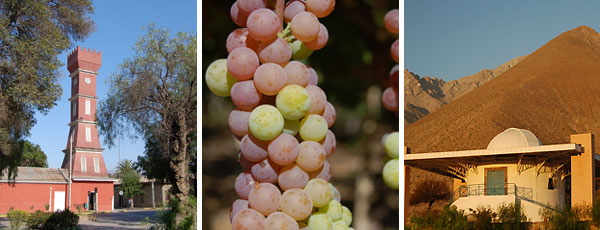 Vicuña - Photos: Marcelo Sola