Tours and Activities:
Flying over the Pacific
When the chosen setting for flying is the sea, the wonder grows. From the air, the coastal geography is transformed into a living map where natural features can be clearly seen.

The Pacific Ocean, located at the height of the Los Lagos Region in southern Chile, has unique features: a landmass broken up by many islands, some close by and others far away. Watching the movement of its waters, cliffs, and rocky promontories from above is an awe-inspiring experience.
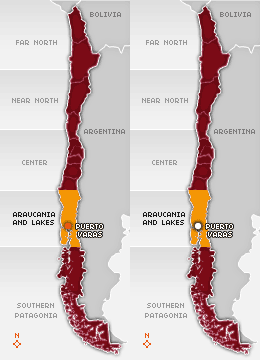
We took off from the Puerto Varas flying club with Santiago Vidal, who aimed his instruments toward the northwest. Gradually, we left behind Lake Llanquihue, Osorno Volcano, and Puerto Montt; we said farewell to their estuaries and headed out to the open sea. Changing course southward, we started to see the massive island of Chiloé; even from high above, we could see the uneven shoreline dotted with bays, fjords, and inlets. Small islets with fishing communities and others inhabited only by marine life appeared before us. Soon, we clearly identified the cities of Ancud and Castro, where we eventually landed.

During the trip, Santiago shared fascinating facts about the history of aviation in the area. Until a few decades ago, Chiloé had very few roads and depended almost entirely on maritime navigation to communicate with the mainland. Health emergencies made the development of civil aviation essential: the Chilean government financed flights to transport the sick, evacuate populations, and fight forest fires.
This need gave rise to flying clubs, which trained highly skilled professional pilots. Today, this tradition lives on in the island's institutions, where piloting maintains a level of excellence recognized throughout Chile.
As we flew over the commune of Ancud, in the north of the island, we spotted the great green lung of Chiloé National Park. A brief bout of turbulence kept us focused on the scene below: unspoiled, untouched, silent nature. We continued south along the coast, crossing several inland lakes, and arrived at Quellón, the last major town at the southern tip of the island.

The conversation with Santiago allowed us to better understand the local economy. From above, we could see the enormous salmon farms, their factory ships, and the plants that produce pellets, the food for the salmon. We also saw fleets of smaller boats, manned by thousands of workers who sustain this constantly growing industry.
From the southern tip of the island, we turned the map around and headed up towards Castro while admiring each of Chiloé's important landmarks. During the landing, we saw its colorful stilt houses, its roads, and the city itself, with its church, main square, and vegetation. If it looked charming from the air, it looked even more beautiful when we touched down.

It was the culmination of a two-hour journey over the violent, blue, and deep Pacific Ocean, where we appreciated its populated and uninhabited islands. We were welcomed by the historic flying club where, since its inauguration in 1946, extraordinary pilots have been trained. We thanked Santiago for the experience and for allowing us to dream, once again, of the magic of contemplating life from the sky.
Contact
Club Aéreo de Castro

 See also:
 © 2007-2026 Total or partial reproduction forbidden. Derechos de Autor 675243 Ley 11723