Tours and Activities:
Essential City Tour Guide
Setting out from the Plaza de Armas in both directions, the promenade leads visitors to many of the city's attractions, which are near each other and accessible by landsea.

Along its extensive waterfront, you can see the Yacht Club, the local port, luxurious cruise ships anchored in the bay, and a little further on, on Angelmó Avenue, the craft fair and the fish and seafood market.
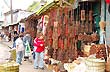
We visited one of the most representative markets in southern Chile, where fishing boats arrive loaded with fresh fish and seafood, and we were able to observe the daily work of the fishermen. In addition to buying products such as cholgas (mussels), machas (clams), pink salmon, locos (abalone), scallops, and picorocos (scallops), you can also eat at food stalls run by women who loudly invite you to enjoy their dishes.
Directly opposite Angelmó is Tenglo Island, separated by the channel of the same name. There, you can take a boatbarge to the island,hire water transport to other islandsthe Chiloé archipelago, depending on the season and availability. Some residents of Tenglo still offer the traditional curanto al hoyo, an experience that should be confirmed in advance.

We leave the market behind and head to Chinquihue, an old fishing village whose wooden stilt houses rise above the tides. This picturesque residential area offers a variety of culinary options, although it is advisable to check its current operating hours before planning your visit.
On another occasion, we decided to travel east from Puerto Montt to visit one of its most popular beach resorts: Punta Pelluco, with its hotels and restaurants. There, the cuisine revolves around salmon, shellfish, and curantos, the culinary tradition of the south, in which local ingredients are cooked today with hot stones and native plant leaves.
Further on from the resort is a fossil forest of larch trees that emerges when the tide goes out. This natural sanctuary is estimated to be between 42,600 and 49,800 years old, according to recent studies, and represents a unique natural heritage of the area.

In addition, the waterfront features several historical monuments. We see a bronze sculpture depicting a family of German immigrants and residents, a tribute to the union of cultures during the colonization period back in 1852. Also on display are the first locomotive from 1906 and a Chilote boat that was used for a long time to transport residents.
To delve deeper into the history of Puerto Montt, we visited the Juan Pablo II Municipal Museum, whose collection covers religious periods, local legends, and part of the historical heritage of the south. Photographs, documents, and antique objects offer a broad view of different eras.
We were moved by the simplicity of the first Jesuit church, built in 1872, with a bell tower dating from 1894 behind it. A few steps from the Plaza de Armas, we found the Diego Rivera Cultural Center, which hosts musical and theatrical activities and excellent exhibitions throughout the year.

These are some of the most significant places we visited during our quick trip to Puerto Montt. We are confident that, with a little more time and curiosity, there are still many more corners, stories, and trails to explore the essence of this coastal city.
 See also:
 © 2007-2025 Total or partial reproduction forbidden. Derechos de Autor 675243 Ley 11723