Tours and Activities:
The Salmon Route
Traveling along the Carretera Austral means discovering a land where nature and industry coexist in harmony. Here, the salmon industry, one of the most important in the country, has begun opening its doors to tourism, offering experiences that reveal this emblematic southern trade from the inside.

The Carretera Austral
A few years ago, AquaChile, one of the country’s most important and prestigious salmon companies, along with local tourism entrepreneurs, began to realize that the salmon industry had grown in parallel with tourism.
This dual momentum led these true “fish factories” to start creating educational spaces and guided tours, allowing travelers to learn up close about the salmon life cycle and daily life around the farming centers.

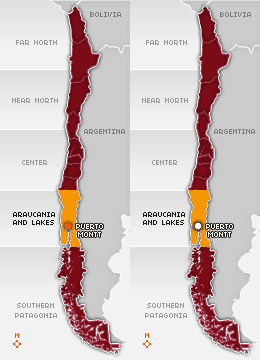
The route usually begins in Puerto Montt, the starting point of a tourist attraction that combines the scenic beauty of the Carretera Austral with the coastline of Caleta La Arena, where several national and international companies operate farming centers.
Charming little towns such as Pelluco, Coihuin, Quillaipe, Metri, Lenca, Chaica, and the Reloncaví Estuary itself add colors, stories, and flavors to a journey that, kilometer by kilometer, teaches travelers about aquaculture and the daily lives of fishermen and rural families surrounded by abundant flora and fauna.
Along the way, travelers can spot subfossil alerce forests visible at low tide, volcanic rocks carried by ancient eruptions, and groups of shellfish gatherers collecting seaweed such as luche and pelillo. These are living postcards that accompany the 47 kilometers connecting Puerto Montt with Caleta La Arena, where the salmon-focused experience begins.

A dream place
As we approach the cove, the landscape blends granite mountains covered in vegetation with deep blue sea, creating a picture-perfect scene. From there, a boat prepared for guided visits transports travelers to the farming platforms and to a nearby sea lion colony, often visible from the water.
Just a few minutes of navigation are enough to reach the platforms. There, hygiene measures require every visitor to place a kind of polyethylene cover over their shoes before stepping onto the structures. This prevents the transmission of diseases to these magnificent fish.
And that is when the show begins: thousands of adult salmon swimming, leaping, turning, and racing from one end of the nets to the other. They move with such energy that, for a moment, it feels as though they aren’t in captivity at all. Although they instinctively sense that a wild and unfamiliar world lies beyond the nets, they also “know” that if they were to escape, that freedom could represent real danger.

A love for salmon
Santiago Vidal began studying Aquaculture Engineering, but over time discovered that his true passion lay in tourism and outreach. Thanks to this combination, he became an experienced local guide and worked with salmon companies and authorities to develop what is now considered one of the most promising tours in the Los Lagos Region.
He explains that “life in the salmon farms also has its own codes." One of the main threats salmon face is the frequent visits from sea lions, which have natural colonies nearby and know there are salmon inside the pens. If a sea lion were to slip into one of these enclosures, it would enjoy a feast worthy of a movie scene, so protections are needed both above and below the water. Floating and submerged nets are essential to this safety system.
But even with all these measures in place, some salmon occasionally escape. The paradox is that these fish, raised in captivity, often remain near the pens even after gaining freedom, since that is where they find food and stay close to their own kind. Life in groups seems far more appealing to them than solitude.

Knowledge of local wildlife, flora, and culture blends with the guide’s anecdotes and the stunning views, making the tour an unforgettable experience.
And as expected, the journey concludes with a tasting of a salmon dish prepared in traditional Chilean style. This fish, a star of southern cuisine, shines in homemade empanadas, hot dishes, and even in some contemporary versions of the traditional curanto.
 See also:
 © 2007-2025 Total or partial reproduction forbidden. Derechos de Autor 675243 Ley 11723