
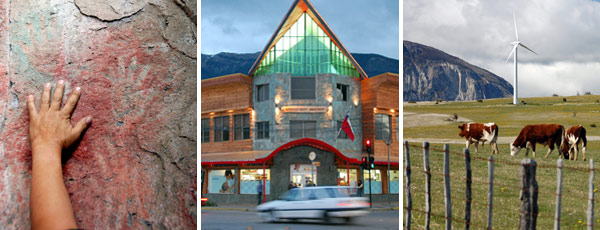
 Coyhaique - Photos: Eduardo Epifanio
 The young City of Coyhaique lies in the province bearing the same name and within the territory of the Eleventh Region of Aysén del General Carlos Ibáñez del Campo. It is the capital of the district, the province and the administrative region.
To access the city by land from Puerto Aisén, visitors must travel 68 kilometers to the East along Route 240. The crossroads with Route 7 must be reached from Puerto Cisnes and 130 kilometers are to be covered up to the Viviana Crossroads. The city lies 48 kilometers towards the southeast, across the Río Simpson Reserve.
The name Coyhaique comes from the Tehuelche words koi, “pond” and áiken “camp”. The city is the place chosen by lovers of adventure, as the area features territories still unexplored by man. Coyhaique is surrounded by a crown of mountains covered by snow during most of the year. It is sometimes referred to as “the city of the everlasting snow”.
Walking down Simpson Street, visitors will catch a glimpse of Piedra del Indio, a rock formation reminiscent of a native man´s silhouette. The best site to observe it is on the bridge across the river. The Handicrafts Market, where local artists and craftsmen display their objects made of wool, leather, pottery, stone and wood, is a must visit.
Just 160 kilometers down Carretera Austral (the Southern Road) towards the Puyuhuapi hot springs, there lies Queluat National Park, to the north of Lake Risopatrón. This protected area spreads along the shore of Seno Ventisquero and spans 154,093 hectares that preserve lush local wildlife, glaciers and rivers.
The most important lakes in Chile may be visited while staying at Coyhaique. Some of them are shared with Argentina: the O´Higgins or Lake San Martín, the General Carrera or Lake Buenos Aires and Lake Cochrane or Pueyrredón. The main rivers (Aisén, Simpson and Baker) are short but plentiful. Natural protected spaces include Laguna San Rafael National Park, featuring the San Rafael and San Quintín Glaciers, and Río Simpson National Reserve.
