Tours and Activities:
Boating the Valdivian Waterways
A surprise awaits even in the remotest corners which can only be reached by boat during this appealing outing full of tourist attractions.

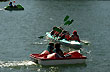
The Valdivian Riverside Market, declared a Typical Zone and National Monument in 2009, is an attraction in itself thanks to its bustling fishing activity and the boats that offer tours departing from there. One of them is the Reina Sofía catamaran, which can carry over 100 passengers and departs regularly from the Schuster Pier. As we boarded, we enjoyed an unforgettable trip through Valdivia´s river network.
Once we had found our places and been given a warm welcome, off we went. The sun made the water sparkle, which seemed to augur a wonderful day. Our expedition guide told us about the landscapes we could be passing through, and we quickly sensed his affection for the place where he was born: near the city´s emblematic Calle Calle River. As we passed beneath the Pedro de Valdivia Bridge, we saw the Collico steamboat, a vessel built in Germany in 1907 that sailed for many years carrying passengers, goods, and small cargo boats. It is greatly respected for the service it has provided over so many years.

As we left the city behind, we cruised by a shipyard on the Calle Calle River and the Universidad Austral de Chile before heading towards the Cruces River Nature Sanctuary, a wetland with abundant native aquatic plants and birds such as red-gartered coots, cranes, and black-necked swans. We then reached Cau Cau, Cruces, Guacamayo, Angachilla, and Naguilán Rivers, where we learnt a lot besides enjoying the amazing wildlife and landscape.
We sailed further and further into the lush, damp, exuberant Valdivian forest. Fishing and sailing boats added even more color to the surroundings. Bewitching stories and legends came up during the conversation with our guide, making our trip really entertaining.

Next, our course shifted toward the coastal area of Niebla, the port of Corral, and Mancera Island. Behind us lay Teja Island, and we had to cross the Cruces Bridge, which connects the city of Valdivia with the coastal areas of Niebla, Los Molinos, and Curiñanco. With its pyramidal shape, it allows large vessels to navigate the river beneath it.
As we traveled along the Valdivia River, we enjoyed the boat´s gentle glide and noticed remnants of the 1960 tsunami, which struck the entire coast and the ships that were there. Several vessels sank in these areas, such as the cargo steamer Canelos, which remains permanently titled.

A port with a story to tell
The Reina Sofía vessel docked at the port of Corral, where we disembarked to visit the San Sebastián de la Cruz Fort, one of the seventeen Spanish fortresses established in the 17th century, as part of the South Pacific Defense System. We then visited the San Pedro de Alcántara Fort on Mancera Island, where we were intrigued by the story of the San Antonio Church, built in 1748 and recognized as the oldest colonial church in southern Chile.
All the forts were built on strategic locations to defend the deep waters of the ports from enemy attacks, although each had its own characteristics according to its specific functions. Old cannons, sentry boxes, long walls that let our gaze wander along the seemingly endless sea horizon, giving us some inkling into the life in these coastal forts.

On the way back to the pier at the Mercado Fluvial we gradually came back into contact with civilization. Our trip along the main seven waterways in Valdivia and our encounter with an important chapter in Chilean history had come to an end.
Contact
Davis Ltda-Motonave Reina Sofía
Tel: +56 63-2207120
Cel: +56 997391230

 See also:
 © 2007-2026 Total or partial reproduction forbidden. Derechos de Autor 675243 Ley 11723