Tours and Activities:
Chacao Channel towards Chiloé
The crossing takes a few minutes and connects you to a world full of nature, as well as the history of those who have always inhabited the island.
The Chiloé archipelago has a unique magnetism: it combines a rich history linked to the early colonization of Chile with spectacular natural landscapes. Currently, to access the island, a ferry service departs from Pargua and connects to the island by crossing the channel. The journey, provided by modern operators, is not only functional but also part of the charm of the trip: the sea crossing continues to be an experience in itself.
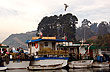
When we arrived by car at the seashore, we could already see the boats, huge and loaded with cars, trucks, and buses, making the reverse journey. In a few minutes, after waiting our turn, we were settled on one of them and began the crossing. In front of us was the northern part of the island of Chiloé, and on both sides the gulfs of Ancud and Corcovado. Although we were moving fast, the motion was almost imperceptible. The day was calm, but at times we could feel the side wind on our faces.

We were able to wave from afar to a small town called Carelmapu, famous for its cove, its well-known “Playa Brava” beach, and its traditional festival of the Virgin of Candelaria. In recent times, there has been debate about a project to build a suspension bridge connecting the mainland to the island, but that plan is currently underway: work on the Chacao Bridge is progressing at a good pace and, once completed, it will replace the ferry with a vehicle crossing that takes only a few minutes.
While we waited to disembark, we consulted the maps and brochures of the area. One of the highlights was Chiloé National Park, a large protected area rich in humid forests with coigües, olivillos, arrayanes, and alerces, among other native species. The local fauna includes native species such as the Chilote fox, the pudú, and emblematic birds; sea lions and otters inhabit the coastal waters.
Upon landing in the town of Chacao, we took the main road south of the island. Before reaching the city of Ancud, we decided to detour to Caulín Bay, renowned for its oyster farms, traditional seafood restaurants, and as a sanctuary for migratory birds. It is an ideal destination for those seeking nature, fresh seafood, and tranquility.

The tranquility of this first stretch of the island was repeated throughout its entire length. Each town told us its story based on its relationship with the churches scattered throughout the archipelago, which still stand despite having been built by the Jesuits in the 17th and 18th centuries. The beaches, some with fine sand and others with pebbles, invited us to stop, walk, and look out at the sea.
The canal, ferries, and island road allow you to venture into a vast island, full of living nature, tradition, and a thousand landscapes to discover. Chiloé is a great invitation for those seeking contact with nature, living history, and the authenticity of coastal towns that preserve their essence.

Contact
Transmarchilay
Tel: +56 65-2467240

Naviera Cruz del Sur Ltda
Tel: +56 65-2621777
 See also:
 © 2007-2026 Total or partial reproduction forbidden. Derechos de Autor 675243 Ley 11723