
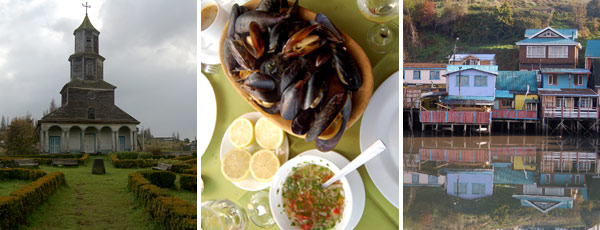
 Castro - Photos: Eduardo Epifanio
 The District of Castro is located in the Province of Chiloé, on the eastern shore of the island bearing the same name, between the Gamboa River estuary and the Ten-tén Marshland. The Great Island of Chiloé is accessed through the Southern Panamerican Road up to Puerto Montt and then by ferry across the Chacao Channel.
The typical feature of the City of Castro is created by the so-called palafitos, houses built on wooden stilts nestled on the seashore. They offer a colorful view.
Fishing is the main activity in the area and it is completed with agriculture, developed on the Rilán Peninsula. Besides, timber is produced and it represents a significant boost for the economy of the city. The beaches called Quento, Tongoy and Yutuy, chosen by the locals as swim holes, lie very close to Castro.
The Churches of Castro, Rilán, Nercón and Chelín, located in the district, were declared World Heritage by UNESCO. The Municipal Park is the venue for various festivals and fairs. If travelers want to catch a nice view of the city, they should not miss the viewpoint at Mount Millantuy, where there is a monument to Virgin Mary.
Towards the east of Castro, lying between the Ancud and Corcovado Gulfs, numerous islands of diverse sizes include Caucahué, Buta-Chauques, Meulin, Quenac, Cahuache, Quinchao, Lemui, Quehui, Chulin, Apiao, Chaulinec, Talcau, Tranqui, Cailin, Laitec, Coldita and San Pedro.
