Tours and Activities:
Flying over the Pacific
As if it were a giant world map, the sea and the land become integrated and magnified while the serenity of experienced pilots makes us notice how far from the ground we can get.

It is well-known that the Pacific Ocean has its own features in the Lake District in southern Chile. Teeming with islands, some of them close to the continent and some others lying further away, observing the movement of the waters and the rocky formations from the air is a dazzling scene.
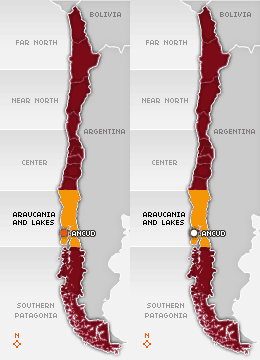
We set out at the airfield of Puerto Varas in the company of Santiago Vidal, who set the instruments heading northwest. Little by little, we left behind Lake Llanquihue, the Osorno Volcano, and Puerto Montt. We bade farewell to the estuaries to fly towards the vast sea. As we turned southwards, we spotted the huge Chiloé Island. In spite of the height, we could discover how wild the coastline is. Small islets with fishermen's villages and others just inhabited by sea fauna appeared before us. Then we made out the Cities of Ancud and Castro, where we would land eventually.

Santiago told us about the history of aviation in the area. In the not-too-distant past, there were no roads on the island, and it was joined to the continent through sea navigation only. However, due to health emergencies, it was essential for planes to reach the required destination promptly. Thus, the Chilean government took into consideration this situation and provided funds for flights to move patients, evacuate people,extinguish forest fires. This led to the emergence of flying clubs that trained professional pilots, first out of necessity and then out of vocation. Today, that tradition lives on: flying clubs in the area not only train pilots, but also offer flying experiences to tourists who want to discover the region from a different perspective.
As we flew over the Community of Ancud, to the north of the island, we spotted the green lung made up by Chiloé National Park. The aircraft experienced a subtle movement so as to keep us alert in front of so much beauty. Unspoiled and intact nature was boasting its silence and quietness. We continued southwards over the shore and crossed several lakes. At last, we reached Quellón, the last important settlement before heading into the South Pacific.

The conversation during the trip revealed some details we did not know. Thanks to it, we discovered the salmon farms with their giant boats and the factories that produce pellets, which are used to feed the salmon. This industry, now key to Chile´s economy, coexists with artisanal fishing, sustained by thousands of men who keep their traditions alive. From the air, we can observe the coexistence of the ancestral and the modern.
We went up the island over the opposite shore towards Castro as we admired each of the main settlements on Chiloé. As we landed, we enjoyed the view of the palafitos painted in a thousand colors, the local roads, and the city itself, with its church, its main square, and its vegetation. If it had looked charming from the air, as we touched ground, it looked even more eye-catching.

Thus ended a two-hour flight over the violent, blue, and deep Pacific Ocean, from where we contemplated both populated islands and unspoiled landscapes. We were welcomed by the historic flying club where, since its inauguration in 1946, extraordinary pilots have been trained. We thanked Santiago for the experience and for allowing us to dream of something as wonderful as contemplating life from the air.
Contact
Sur Marino
Tel: +56 65-2431660
Cel: +56 994970272
Club Aéreo de Castro

 See also:
 © 2007-2026 Total or partial reproduction forbidden. Derechos de Autor 675243 Ley 11723